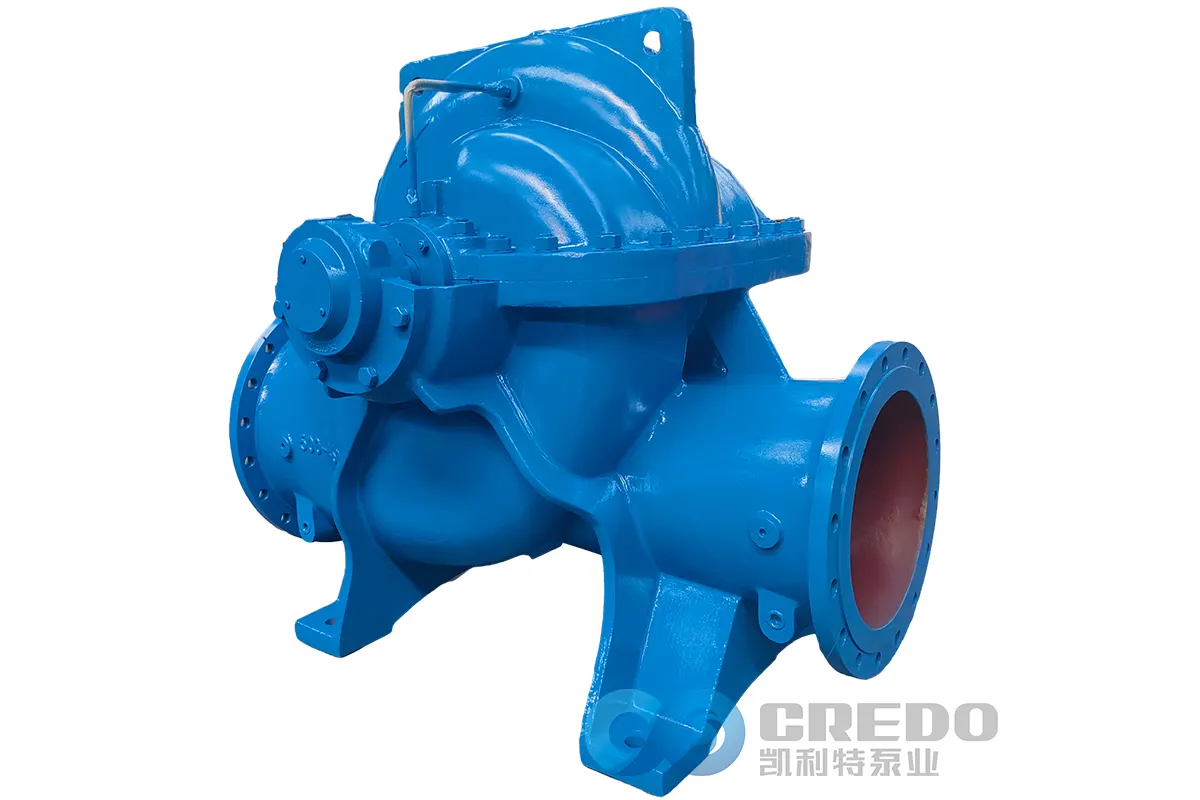
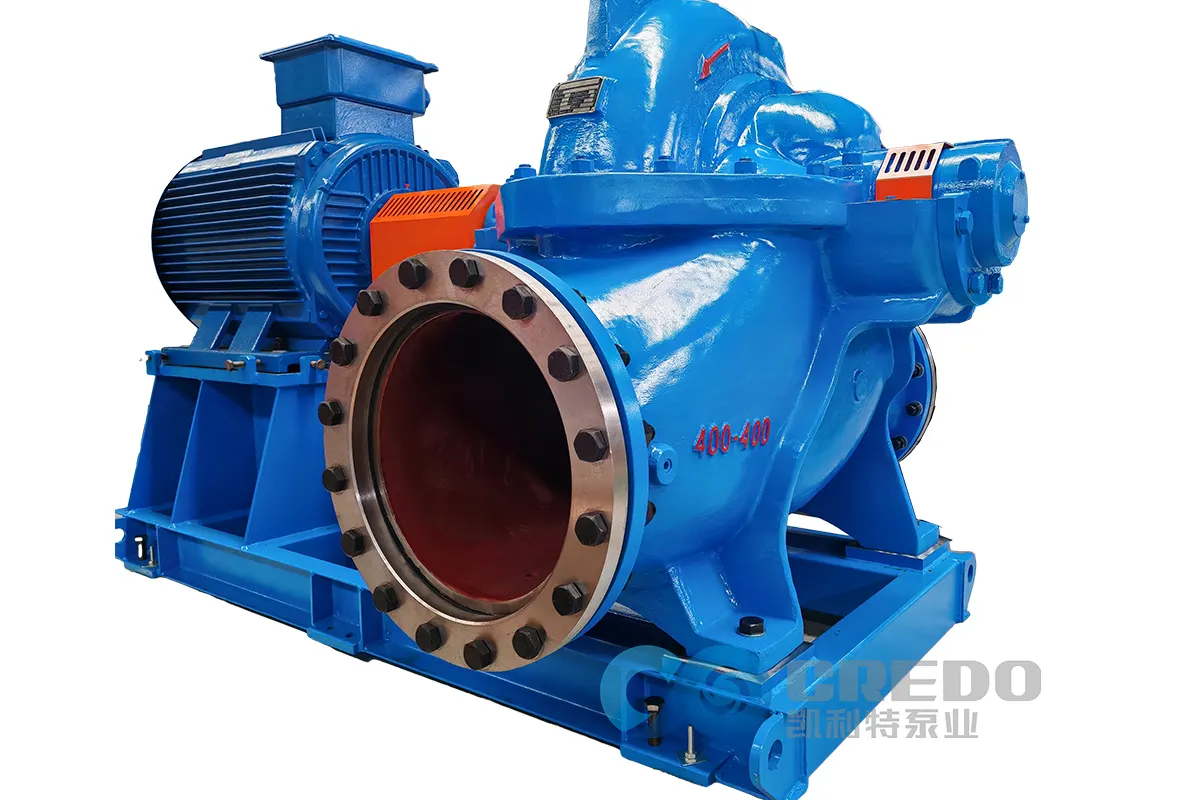
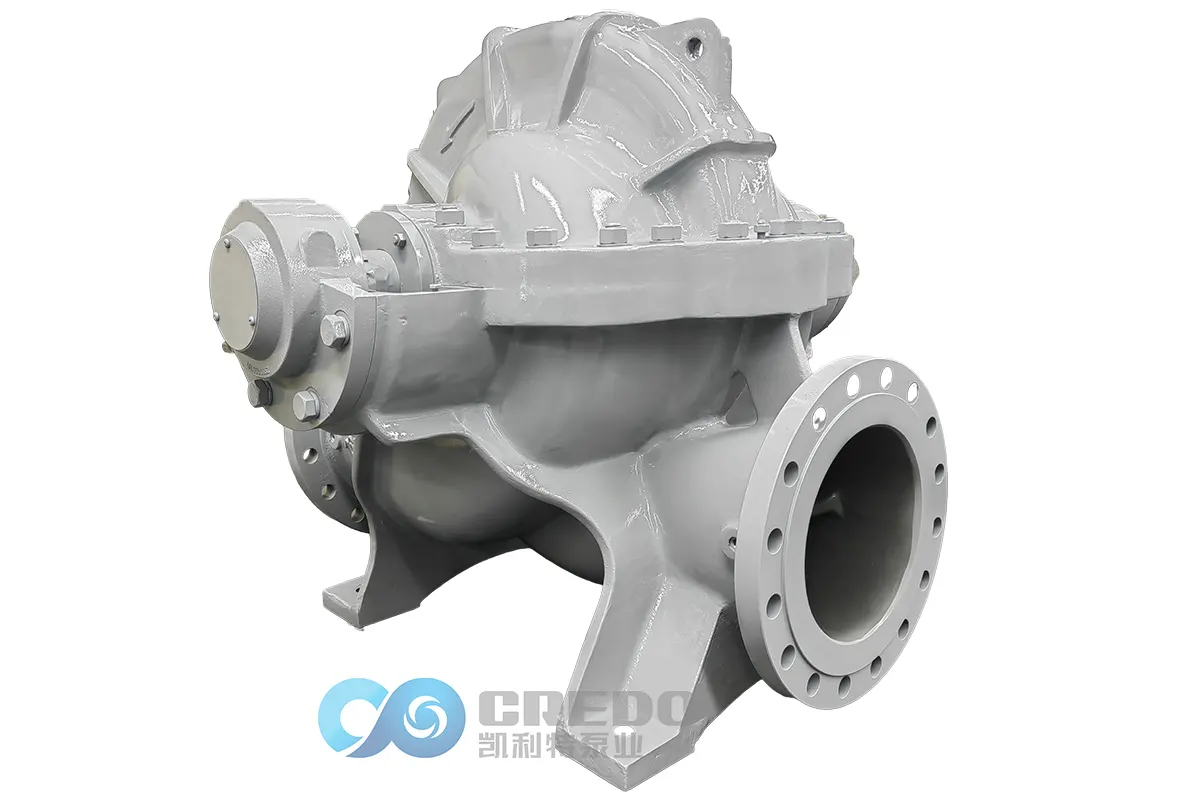
What Should I Do if the Outlet Pressure of a Split Case Pump Drops?
Split case pumps are widely used in industrial, municipal, and commercial applications. A sudden drop in outlet pressure can affect system performance. This guide explains common causes and recommended corrective actions to restore normal pump operation.
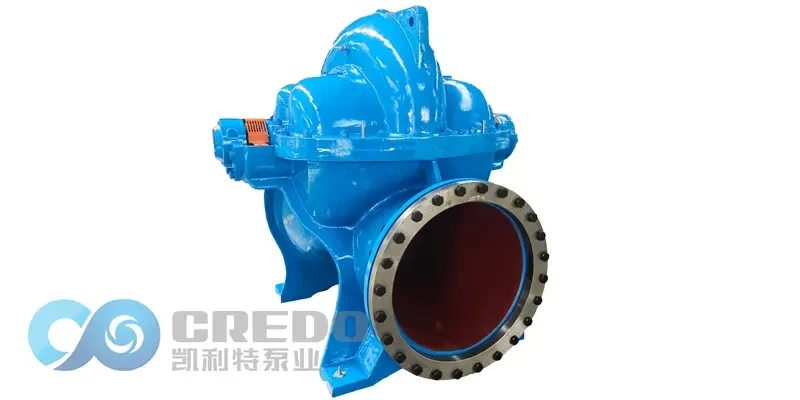
Common Troubleshooting for Split Case Pump Issues
| # | Problem | Possible Cause | Corrective Action |
| 1 | Motor Reversal | Wiring issues may cause the motor to rotate in the wrong direction. | Always check rotation direction before starting. If reversed, swap any two motor terminal wires. |
| 2 | Operating Point Shifts to High Flow / Low Head | Reduced system backpressure causes the pump to operate in the low-head, high-flow region. | Slightly close the discharge valve to restore normal pressure. |
| 3 | Pump Speed Reduction | Pump head is proportional to the square of the speed; any speed drop reduces outlet pressure. | Measure actual pump speed, find the cause, and restore the correct speed. |
| 4 | Inlet Cavitation | Suction pressure below liquid vapor pressure causes cavitation. | Check for blockages, ensure inlet valve is fully open, or raise suction tank liquid level. |
| 5 | Internal Leakage | Excessive gap between rotating and stationary parts reduces discharge pressure. | Inspect and repair/replace worn parts, such as impeller wear rings. |
| 6 | Impeller Flow Path Blockage | Partial blockage hinders flow. | Disassemble to remove debris; consider installing a suction strainer. |
Conclusion:
Timely diagnosis and preventive maintenance are crucial. Regular inspections, correct installation, and adherence to manufacturer guidelines will help maintain optimal pump performance.
FAQ – for Split Case Pump
Learn about the key spare parts commonly used in split case pumps.
| Split Case Pump Spare Parts & Qty (2 Years) | ||||||||
| For Packing Seal Pump | ||||||||
| Spare Parts/Qty | Pump Qty (Including Spare Pump) | |||||||
| 1 | 2 | 3 | 4 | 5 | 6 | 8 | ≥10 | |
| Shaft Sleeve | 1 | 1 | 1 | 2 | 2 | 3 | 4 | 5 |
| Bearing Collar | 1 | 1 | 1 | 2 | 2 | 3 | 4 | 5 |
| Impeller Collar | 0 | 0 | 0 | 1 | 1 | 1 | 2 | 3 |
| Packing Seal | 1 | 2 | 3 | 4 | 5 | 6 | 8 | 10 |
| O Ring | 1 | 2 | 3 | 4 | 5 | 6 | 8 | 10 |
| Shaft | 0 | 0 | 0 | 1 | 1 | 1 | 2 | 3 |
| Impeller | 0 | 0 | 0 | 1 | 1 | 1 | 2 | 3 |
| Wear Ring | 1 | 1 | 1 | 2 | 2 | 3 | 4 | 5 |
| Packing Ring | 0 | 0 | 0 | 1 | 1 | 1 | 2 | 3 |
| Packing Gland | 0 | 0 | 0 | 1 | 1 | 1 | 2 | 3 |
| Bearing | 1 | 1 | 1 | 2 | 2 | 3 | 4 | 5 |
| For Mechanical Seal Pump | ||||||||
| Spare Parts/Qty | Pump Qty (Including Spare Pump) | |||||||
| 1 | 2 | 3 | 4 | 5 | 6 | 8 | ≥10 | |
| Shaft Sleeve | 1 | 1 | 1 | 2 | 2 | 3 | 4 | 5 |
| Bearing Collar | 1 | 1 | 1 | 2 | 2 | 3 | 4 | 5 |
| Impeller Collar | 0 | 0 | 0 | 1 | 1 | 1 | 2 | 3 |
| Mechanical Seal | 1 | 1 | 1 | 2 | 2 | 3 | 4 | 5 |
| O Ring | 1 | 2 | 3 | 4 | 5 | 6 | 8 | 10 |
| Shaft | 0 | 0 | 0 | 1 | 1 | 1 | 2 | 3 |
| Impeller | 0 | 0 | 0 | 1 | 1 | 1 | 2 | 3 |
| Wear Ring | 1 | 1 | 1 | 2 | 2 | 3 | 4 | 5 |
| Mechanical Gland | 0 | 0 | 0 | 1 | 1 | 1 | 2 | 3 |
| Bearing | 1 | 1 | 1 | 2 | 2 | 3 | 4 | 5 |
Discover how to select the right split case pump materials based on fluid properties and operating conditions.
| Pump Parts | For Clear Water | For Sewage | For Seawater |
| Casing | Cast Iron | Ductile Iron | S.S / Super Dulex |
| Impeller | Cast Iron | Cast Steel | S.S / Super Dulex / Tin Bronze |
| Shaft | Steel | Steel | S.S / Super Dulex |
| Shaft Sleeve | Steel | Steel | S.S / Super Dulex |
| Wear Ring | Cast Iron | Cast Steel | S.S / Super Dulex / Tin Bronze |
| Remark | Final material depends on the liquid condition or the client’s request. | ||
Follow the essential installation steps to ensure safe and reliable operation of the split case pump.
| Standardized Installation Procedure for Split Case Pump | |||
| Work Stage | No. | Main Steps | Key Operations & Notes |
| I. Pre-Installation Preparation | 1 | Site & Foundation Inspection | • Clean the installation site and ensure sufficient space for operation and lifting. • Check the concrete foundation strength, dimensions, elevation, and anchor bolt positions according to drawings. The foundation surface should be flat and free of oil. |
| 2 | Equipment Unpacking & Inspection | • Verify that the pump, motor, and accessories match the contract specifications. • Inspect the equipment for any transportation damage and ensure all parts are complete. • Check that all accompanying documents (drawings, manuals, certificates) are complete. | |
| 3 | Tools & Material Preparation | • Prepare lifting equipment (hoist, sling), shims, level, dial indicator, wrenches, feeler gauge, lubricants, sealant, etc. • Prepare cleaning agents and cloths for cleaning mating surfaces. | |
| II. Pump Body Installation | 4 | Lifting & Positioning | • Lift the pump using the lifting holes or lugs; never lift by the pump shaft or inlet/outlet pipes. • Place the pump on the foundation, insert anchor bolts into base holes, do not tighten yet. |
| 5 | Initial Leveling & Alignment | • Place a level on the pump’s inlet/outlet flange or machined surface, adjust shims to roughly level the pump (tolerance ≤0.1 mm/m). • Use the pump shaft centerline as a reference to preliminarily align the pump. | |
| 6 | Primary Grouting | • Pour high-strength non-shrink grout into the anchor bolt holes; the grout layer should be dense and slightly below the foundation surface. • Curing: wait until the grout is fully cured (usually 3–7 days) before fine adjustment and tightening. | |
| 7 | Final Leveling & Alignment | • After grout curing, tighten anchor bolts. • Recheck pump level with a precision level. • Motor installation & alignment: lift the motor in place, use a dial indicator or laser alignment device, align the motor to ensure pump and motor shafts are coaxial (radial & axial deviation ≤0.05 mm). Tighten motor anchor bolts after alignment. | |
| III. Piping & Accessories Installation | 8 | Piping Connection | • Principle: never force pipe connections using the pump flanges to avoid stress on the pump body. • Piping should be independently supported, ensure natural alignment without stress. • It is recommended to install expansion joints near the pump inlet/outlet to absorb thermal expansion/contraction and installation errors. |
| 9 | Seals & Cooling System | • For mechanical seals, connect flushing/cooling piping, ensure smooth flow, flushing pressure 0.05–0.15 MPa higher than seal chamber. • For packing seals, install packing and adjust gland tightness (do not overtighten initially). | |
| 10 | Lubrication & Instruments | • Add specified grade and quantity of lubricant to bearing housing to oil mark midline. • Install pressure gauge, thermometer, etc.; pressure gauge should be between pump outlet and first valve. | |
| IV. Post-Installation Checks & Test Run | 11 | Final Checks | • Manual rotation: rotate coupling, ensure rotor turns smoothly, no friction or binding. • Check all bolts are tightened and guards are in place. • Jog motor: confirm rotation direction matches pump casing arrow. |
| 12 | Priming & Test Run | • Open inlet valve, fill pump with conveyed medium, completely expel air. • Close outlet valve, start motor. • Slowly open outlet valve to desired condition, check pressure, flow, vibration, noise, bearing temperature (≤80 ℃), and seal leakage. Test run ≥2 hours. | |
Explore proper disassembly and maintenance procedures to maximize the split case pump service life.
| Standardized Disassembly & Maintenance Procedure for Split Case Pump | |||
| Work Stage | No. | Main Steps | Key Operations & Notes |
| I. Pre-Disassembly Preparation | 1 | Shutdown & Isolation | • Safety first: slowly close the outlet valve, cut off power, and apply lockout/tagout (LOTO). • Close the inlet valve, open the pump vent and drain valves, completely drain the medium. For toxic or hazardous media, perform purging and verify safe conditions. |
| 2 | Disconnect External Connections | • Remove coupling guard and connecting bolts. • Disconnect all pipes, instrumentation lines, and cooling/seal water lines if the pump will be lifted as a whole. Seal open ends to prevent foreign object entry. | |
| 3 | Tools & Preparation | • Prepare pullers, hydraulic wrenches, copper bars, lifting equipment, and various wrenches. • Prepare parts boxes and labels to organize and mark removed bolts and small parts for easier reassembly. | |
| II. Pump Body Disassembly | 4 | Remove Accessories | • Remove pressure gauges, thermometers, and other instruments. • Open bearing housing oil drain and collect used lubricant. |
| 5 | Remove Coupling & Bearing End Covers | • Use a puller to smoothly remove the half-coupling from the pump shaft; avoid hammering. • Remove bearing end covers and gland bolts in sequence, then remove the covers. | |
| 6 | Lift Out Rotor Assembly | • Remove bearing housing bolts on both sides of the pump and horizontally lift the entire rotor assembly (shaft, impeller, bearings, sleeves) smoothly. Avoid collisions. | |
| 7 | Disassemble Split Case Pump Body | • Loosen and remove pump casing bolts in a diagonal sequence. • Lift the pump casing carefully and place on a padded or wooden platform. Protect the split case mating surface—avoid dents or scratches. | |
| 8 | Remove Internal Components | • Before disassembly, measure and record key clearances (e.g., impeller to wear ring, bearing clearance). • Use special wrenches to remove impeller locknut, then remove impeller. Remove shaft sleeve, mechanical seal or packing housing sequentially. | |
| III. Inspection, Maintenance & Reassembly | 9 | Parts Cleaning, Inspection & Measurement | • Clean all parts thoroughly, inspect for wear, corrosion, cracks. Focus on: – Impeller: cavitation, wear, dynamic balance. – Wear ring/seal ring: measure wear gap; replace if exceeding limits (typically >1.5× original gap). – Pump shaft: check straightness (total runout ≤0.05 mm). – Bearings: check clearance, rolling surface for pitting or spalling. – Mechanical seals: check stationary/rotating faces and spring elasticity. • Decide whether to repair or replace parts. |
| 10 | Reassembly (Reverse Order of Disassembly) | • Core principle: clean, align, and tighten evenly. • Replace all seals (O-rings, gaskets). Apply a thin layer of sealant (e.g., anaerobic) on split case mating surfaces. • Lift pump casing, tighten bolts diagonally in stages to manufacturer torque. • Reinstall rotor assembly, adjust impeller axial clearance to manufacturer spec. • Install bearings and adjust bearing clearance. • Reinstall coupling and perform precise pump-to-motor alignment (same as installation standard). | |
| 11 | Final Verification | • Manually rotate to ensure smooth, unrestricted motion. • Connect piping, add new lubricant to specified level. • Conduct final verification according to installation procedure “Priming & Test Run” to ensure normal operation parameters. | |
Find practical solutions to the most common split case pump operating issues.
| Split Case Pump Common Faults and Solutions | ||
| Problem | Causes | Solutions |
| 1. Pump not priming / Cannot discharge liquid | 1. Suction pipe, suction valve, foot valve not primed; air ingress. 2. Pump casing or suction pipe contains trapped air. 3. Motor rotation reversed. 4. Suction inlet leakage or failure. 5. Suction lift exceeds allowable maximum. | 1. Prime suction line and foot valve; eliminate air leaks. 2. Vent casing & suction line. 3. Correct motor wiring/rotation. 4. Repair suction inlet. 5. Reduce suction lift or add booster. |
| 2. Flow insufficient / Small discharge | 1. Inlet valve closed or partially closed; suction screen blocked. 2. Impeller blockage, foreign objects. 3. Wear at suction port (seal ring), impeller or casing wear. 4. Suction line contains air. 5. Pump speed too low. | 1. Fully open inlet valve; clean filter/screen. 2. Remove blockage/clean impeller. 3. Repair/replace worn components. 4. Purge air from suction. 5. Restore correct operating speed. |
| 3. Low head / Insufficient pressure | 1. Impeller clearance too large or impeller damage. 2. Low rotation speed. 3. Cavitation. 4. Suction pipe diameter too small. 5. Discharge head exceeds pump capacity. | 1. Adjust or replace impeller. 2. Increase speed within rating. 3. Improve suction conditions or reduce NPSH. 4. Increase suction pipe size. 5. Reduce discharge head. |
| 4. Excessive vibration / Abnormal noise | 1. Shaft misalignment. 2. Bearing damage. 3. Loose motor mounting. 4. Coupling or impeller imbalance. 5. Motor vibration. 6. Base/frame loose. 7. Improper pipe support causing resonance. | 1. Re‑align pump & motor. 2. Replace bearings. 3. Secure motor base. 4. Correct balance; inspect coupling. 5. Reduce motor vibration. 6. Tighten base. 7. Add pipe supports. |
| 5. Bearing overheating | 1. Improper lubrication (insufficient, wrong type, contaminated). 2. Bearing damage. 3. Poor alignment. 4. Bearing housing misfit. 5. Insufficient cooling. 6. Excessive rotational speed. | 1. Re‑lubricate with correct grease/oil. 2. Replace bearings. 3. Realign pump & motor. 4. Adjust housing fit. 5. Improve ventilation/cooling. 6. Operate within speed rating. |
| 6. Mechanical seal leakage | • Seal faces worn, uneven, O‑ring aging, spring failure. • Packing not lubricated or tightened. | • Replace mechanical seal and O‑rings; inspect shaft finish. • Adjust packing gland; ensure correct packing and tension. |
| 7. Motor overload / Tripped protection | 1. Insufficient power supply. 2. Phase loss / Power imbalance / Poor wiring. 3. Excessive load (impeller blockage), pump stalled. 4. Excessive starting current. 5. Motor overheating. 6. Short‑circuit or earth fault. | 1. Restore proper supply voltage. 2. Check wiring and phases; correct imbalance. 3. Remove blockage; clear shaft rotation. 4. Use soft start or reduced voltage starter. 5. Improve cooling. 6. Find & repair electrical fault. |
| 8. Cannot start or slow start | 1. Power supply abnormal (voltage drop). 2. Starter contactor open. 3. Motor winding open circuit. 4. Control circuit faulty. | 1. Check power and restart. 2. Check and replace contactor. 3. Repair/replacement of winding. 4. Correct control wiring. |
| 9. Pump vibration increases at no load | 1. Rotor imbalance, bent shaft. 2. Loose rotating parts. 3. Coupling looseness. 4. Pump suction/delivery line back‑pressure issue. | 1. Balance rotor or repair shaft. 2. Tighten rotating assembly. 3. Tighten coupling. 4. Eliminate back‑pressure and correct piping. |
| 10. Efficiency drop / Performance deterioration | 1. Wear of impeller & casing. 2. Internal passage clogging, scale/slag. 3. Air entrainment in suction. 4. Operating point far from BEP. | 1. Replace worn parts. 2. Clean flow passages; flush. 3. Eliminate suction air leaks. 4. Adjust operating conditions toward BEP. |
Learn the maintenance practices that help improve split case pump reliability and reduce downtime.
| Daily Maintenance and Care for Split Case Pumps | ||
| Maintenance Category | Maintenance Item | Details & Standards |
| I. Pre‑Operation Inspection | 1. Visual & Connection Check | • Check the pump casing, motor, coupling, etc., for cracks, deformation or damage. • Check all connection fasteners (especially pump‑to‑base and base bolts) for tightness to prevent leakage or vibration. • Check piping and joint areas for looseness. |
| 2. Lubrication Inspection | • Oil lubrication: Check if the oil level in the oil chamber is at the center mark; whether the oil is clean. Replace promptly if oil is turbid or contains impurities. • Grease lubrication: Check if the grease is sufficient and clean. Note: Water‑based bearings use grease X; motors use grease Y — the two must not be mixed. | |
| 3. Turn Shaft & Rotation Confirmation | • Manually rotate the coupling to check if the pump shaft rotates freely with no friction noise. • Start motor briefly to confirm the rotation direction is consistent with the direction indicated by the pump arrow. | |
| 4. Seal & Suction Check | • Check the mechanical seal and packing seal condition. • Open pump suction valve and drain water until the casing is full, then vent air (no dry running). | |
| II. Monitoring During Operation | 1. Parameter Monitoring | • Pressure & Flow: Monitor inlet and outlet pressures and flow to ensure operation within the rated range for optimum efficiency. • Bearing Temperature: Bearing temperatures should remain between 40–60 °C, and the motor temperature should not exceed 80 °C. If overheated, check lubrication and cooling systems. |
| 2. Vibration & Noise | • Listen to running noise: should be smooth hum. If there are abnormal noises, impacts, etc., stop and inspect immediately. • Observe vibration condition; abnormal vibration may indicate imbalance, bent shaft, uneven wear, or cavitation. | |
| 3. Seal & Leakage Monitoring | • Mechanical seal: Normal leakage rate should not exceed 5 drops per minute. • Packing seal: Through adjustment tighten, leakage rate should be controlled at about 10‑15 drops/min (approx. 30 ml/min) depending on packing size. Adjust to desired leakage. | |
| 4. Instruments & Motor | • Check all instruments (pressure gauge, temperature gauge, etc.) for normal readings. • Check motor current and electrical system; no abnormal heating. | |
| III. Periodic (Planned) Maintenance | 1. Lubrication Management | • Oil lubrication: Change first after 100 operating hours, then every 500 hours. • Grease lubrication: Generally replenish or change every 3 months; follow manufacturer service schedule. |
| 2. Seal System Maintenance | • Packing seal: Replace packing rings as needed; ensure stuffing box is properly tightened and align packing ring gaps at 90°–120°. • Mechanical seal: Check flushing liquid pressure; it should be 0.05–0.1 MPa. Replace seal if excessive wear or leakage. | |
| 3. Bearing & Coupling Check | • Monthly manually check coupling and shaft for smooth rotation, no abnormal noise. • Periodically check bearing housing for dirt, wear and proper lubrication. | |
| 4. Impeller & Flow Passage Cleaning | • Every 3 months or based on water quality, check impeller for buildup, corrosion, wear; clean off sediment, debris.• Check impeller clearance; if gap is too large (e.g., >0.1 mm), replace as required. | |
| 5. Alignment & Tightening | • Periodically check alignment between pump and motor; allowable deviation ≤0.05 mm. • Retighten base bolts and major fasteners as needed. | |
| IV. Shutdown & Long‑Term Stop | 1. Normal Shutdown | • Procedure: close outlet valve first → power off → close inlet valve and pressure gauge valves. |
| 2. Winter Anti‑Freeze | • When ambient temperature is ≤ 0 °C, after shutdown drain water from pump body, and ensure piping is drained to prevent freezing. | |
| 3. Long‑Term Storage | • Drain all internal water and clean thoroughly. • Apply rust preventive oil (shaft, impeller, contact areas), reinstall and protect for storage. | |
| V. Cleaning & Record Keeping | 1. Equipment Cleaning | • Weekly wipe pump body, motor, and base surfaces; especially clean motor cooling fins. • Regularly clean around instrument panels to prevent dust accumulation. |
| 2. Operation Records | • Establish and maintain operation & maintenance logs including operating hours, pressures, temperature, vibration, lubrication replacement time, fault handling, etc., to facilitate equipment condition tracking and planned maintenance. | |
Related Posts